Categories: COP
Tags: Antalya, COP31, Salome Owuonda, Türkiye
COP31 is officially behind us. After a closing ceremony initially expected on Friday evening stretched into Sunday afternoon, we witnessed approximately 44 hours of extended negotiations and deliberations, making this one of the longest closing processes in the history of climate COPs.
But what exactly happened, and why did it take so long? First, there were some important wins.
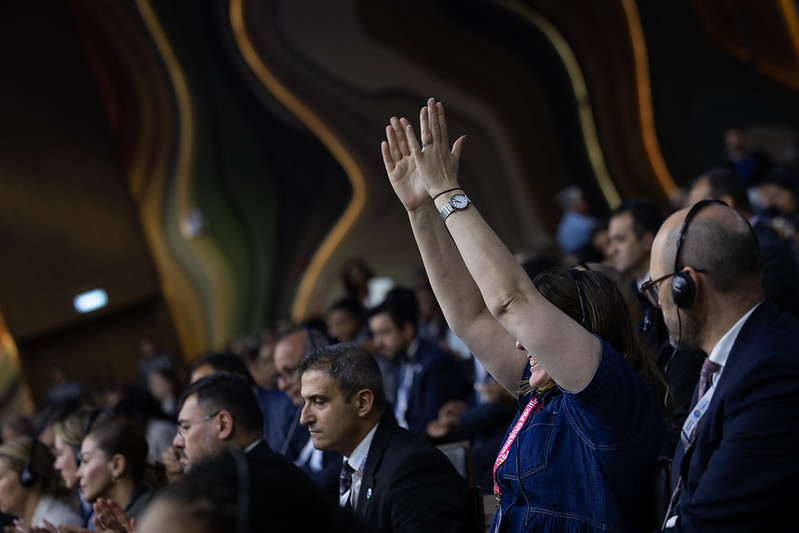
For the first time, the Climate Finance Work Programme was adopted as a standalone agenda item. This was a significant victory for developing countries, particularly marginalized communities whose livelihoods, resilience and, in many cases, survival depend on climate finance that is accessible, predictable, adequate and fit for purpose.
But as they say, we win some battles and lose others. Despite strong calls to triple adaptation finance, we did not secure the outcome we had hoped for. The issue was discussed extensively in negotiation rooms, but Parties could not reach agreement on the necessary commitments.
So, why did the closing process stretch to 44 hours? The answer lies in the nature of multilateral climate negotiations. The COP is a Party-driven process, where decisions are adopted by consensus. This means that even one Party’s objection can prevent an agreement from being adopted. Each country comes to the negotiating table with its own national circumstances, priorities, interests and, importantly, red lines. This is what we witnessed in the negotiation rooms, with disagreements eventually spilling over into the closing plenary.
For instance, some Parties pushed for stronger commitments towards phasing out fossil fuels, while others emphasized that such transitions must be pursued within the principles of equity and just transition, taking into account different national circumstances and development priorities.
Another major point of contention concerned the means of implementation, particularly climate finance. Developing countries continued to emphasize the importance of upholding the commitments and principles enshrined in Articles 3.1, 4.3, and 4.4 of the United Nations Framework Convention on Climate Change (UNFCCC), commonly referred to in the negotiation rooms as the Convention, alongside Articles 2.2, 9.1, and 9.3 of the Paris Agreement.
Yet, some of the discussions appeared to reopen previously agreed understandings, raising concerns about the possibility of weakening established commitments. And this is where the negotiations become difficult.
While Parties debate language, obligations and responsibilities, communities on the frontlines continue to suffer the devastating impacts of climate change. Many of these communities have contributed the least to the crisis, yet they bear some of its heaviest consequences. Meanwhile, countries with significant historical responsibility for greenhouse gas emissions remain central to the debates over the scale and nature of climate action and support.
In climate negotiations, previously agreed language carries significant weight. There is a strong expectation that negotiated consensus should be respected and that subsequent agreements should build on, rather than dilute, earlier commitments.
This also explains why some Parties expressed reservations about introducing new terminology, such as information integrity, without first establishing a shared understanding of its meaning, scope and implications.
For example, what would information integrity mean for Local Communities and Indigenous Peoples’ traditional knowledge? Who determines what constitutes credible or legitimate knowledge? Whose standards would apply, and how would communities with limited financial, technological or institutional resources be affected?
These are not merely semantic questions. Language negotiated at COP can eventually shape policies, financing arrangements, institutional practices and access to resources. Terminology introduced without adequate safeguards could unintentionally disadvantage the communities that climate action is intended to protect.
As many negotiators often say, no deal is better than a bad deal. We must not become the generation that reverses the gains secured by those who negotiated before us.
Climate negotiations should be progressive, not regressive. We have a responsibility to safeguard existing commitments while negotiating stronger, fairer and more ambitious outcomes.
Equally, we must be cautious about introducing new concepts and positions that, rather than strengthening the resilience of present and future generations, could ultimately undermine their rights, opportunities and well-being.
But do these lengthy negotiations actually produce results? Absolutely!
The outcomes of climate negotiations are not always immediately visible. Some take years, even decades, to translate into tangible benefits for countries and communities.
Take Kenya, for example. During COP31, Kenya signed a carbon market cooperation agreement with Singapore. This development builds on years of negotiations under Article 6 of the Paris Agreement, which established the framework for international cooperation through carbon markets. This is an indication that the decisions made in negotiation rooms can eventually translate into bilateral cooperation, investment opportunities and climate action on the ground.
So, while the process may appear painfully slow, these negotiations are not a waste of time. We are talking about building consensus among 198 Parties, each representing different social, economic, environmental and political realities, and collectively making decisions that affect billions of people. That is no small task!
As we close the COP31 chapter, our eyes now turn to COP32 in Addis Ababa, Ethiopia, in 2027.
COP32 will be significant for Africa. With several unresolved issues and agenda items carried forward, the negotiations are expected to be demanding. But they also present an opportunity for Africa to amplify its priorities, particularly on adaptation, climate finance, just transition, loss and damage and the protection of vulnerable communities.
For those of us who spent much of COP31 inside the negotiation rooms, the experience has been both intellectually enriching and, at times, deeply frustrating. But it has also reinforced an important conviction: multilateralism, however imperfect, remains indispensable to achieving climate justice.
The work continues. The commitments must translate into action. And the voices of those most affected by climate change must remain at the centre of the process.
Hoşça kal, Antalya! Selam, Addis Ababa!
By Salome Owuonda,
Executive Director of the Africa Centre for Sustainable and Inclusive Development (Africa CSID),
a Kairos Canada solidarity partner.
Salome was in Antalya, Türkiye for the full COP31 negotiations, funded in part by Kairos Canada. For more of her conference coverage, visit:
November 16 – COP31 at a crossroads: progress, deadlocks and the push for climate action
November 10 – Reflections from COP31 Antalya’s first day