Categories: Africa, Human Rights
Introduction by Rachel Warden
In August 2026, Kairos provided a solidarity grant to OilWatch Africa (OWA), a long-standing partner, to participate in the World Social Forum (WSF) in Benin August 4-8.
In his reflection, Noble Wadzah, OWA coordinator, writes about his experience and learnings participating in the WSF – sharing information, networking and participating in panels, including his presentation “Climate Response and Reparative Justice: Walking on a Tight Rope”.
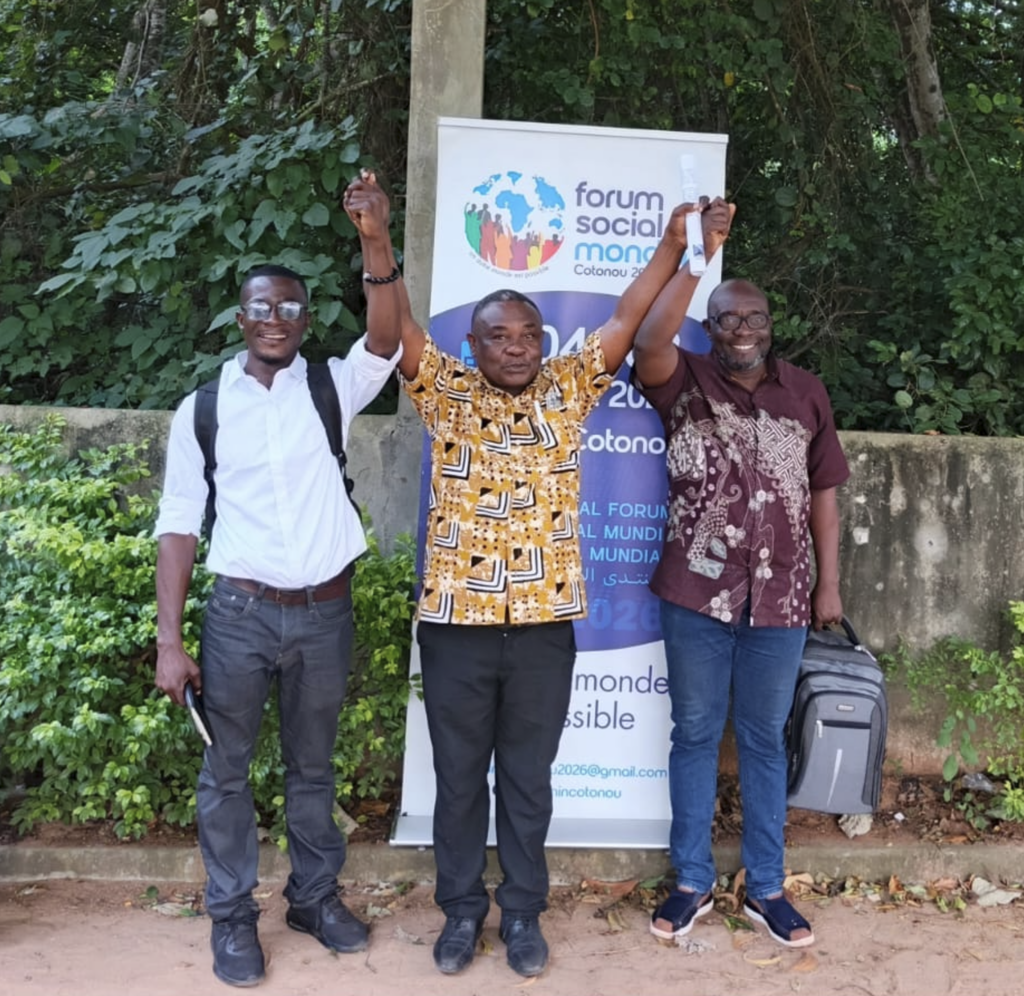
His reflection highlights the power of civic resilience and resistance in the face of government restrictions days before the Forum’s commencement and concludes with the power of the people to shape their future.
The World Social Forum 2026 was a living expression of global solidarity, by Noble Wadzah
Civic Resilience, Reparative Justice and Africa’s Development Agenda
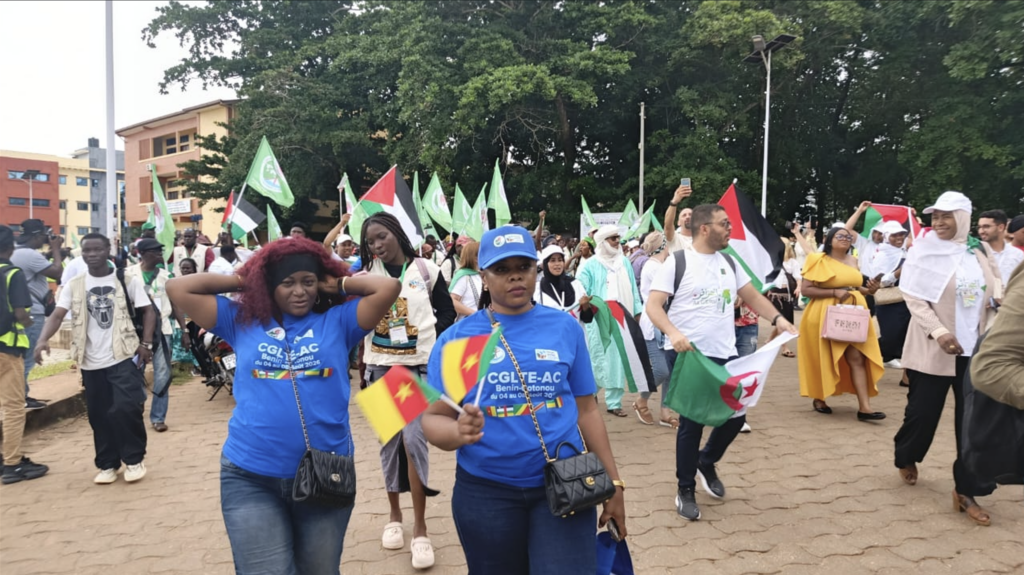
In August 2026, the World Social Forum (WSF) convened in Benin, West Africa, marking another historic moment for Africa as host of one of the world’s most influential gatherings of civil society, social movements and grassroots organizations. The Forum brought together thousands of participants from across the Global South to deliberate on justice, equality, climate action, human rights and the future of international solidarity.
Although the Forum began under uncertain circumstances, it ultimately became a powerful demonstration of civic resilience and the collective strength of people’s movements.
From Uncertainty to Collective Triumph
The opening days of the Forum were overshadowed by restrictions imposed by the Beninese government, threatening the space for meaningful participation after years of preparation. However, sustained engagement, negotiation and coordinated advocacy by civil society organizations resulted in a remarkable reversal of that position. What initially appeared to be a setback became one of the Forum’s strongest lessons: organized citizens possess the power to influence political decisions through peaceful and persistent action.
The experience reaffirmed that democratic space is rarely guaranteed; it is often secured through vigilance, solidarity and collective resolve.

Why Benin Matters
Benin was a profoundly symbolic venue for the 2026 World Social Forum. Beyond its geographical location, the country occupies a significant place in the history of the Trans-Atlantic Slave Trade – one of humanity’s greatest crimes, as recognized by the United Nations.
Its coastal towns and historical sites stand as enduring reminders of forced displacement, suffering, resistance and complex negotiations that shaped centuries of African history. Holding the Forum in Benin therefore connected contemporary struggles for justice with one of the deepest historical wounds inflicted upon the African continent.
The University of Abomey Calavi
The Forum transformed its host city into an open university without walls. Lecture halls, public squares, gardens and walkways became spaces of continuous learning and exchange. Academic presentations, public lectures, policy debates, exhibitions and community fairs unfolded simultaneously, creating an atmosphere where knowledge was freely shared across generations and cultures.
Equally memorable was the cultural spirit that animated the gathering. Music, art, storytelling and performances celebrating the identities and aspirations of the Global South created an environment of warmth, belonging and shared humanity. The WSF was not merely a conference—it was a living expression of global solidarity.
Expanding the Meaning of Reparative Justice
One of the most important conversations through Oilwatch Africa’s channel centered on Reparative Justice. For many, reparations have traditionally been understood primarily as financial compensation for the historical injustices of slavery and colonialism. The discussions in Benin challenged that narrow interpretation by introducing broader dimensions of justice that include environmental, economic and climate-related harms.
OWA Africa’s presentation, “Climate Response and Reparative Justice: Walking on a Tight Rope,” contributed significantly to this expanded understanding. The presentation explored the relationship between energy transition, natural resource governance and what was described as Fiscal Extraction – the social and economic costs imposed on resource-rich African countries through investor-state dispute settlements and costly international arbitration awards.
A participant reflected afterwards:
“This presentation has broadened my understanding of the links between energy transition and reparative justice. It reveals a hidden cost that resource-host communities and countries continue to bear.”
This perspective challenges policymakers to recognize that extraction is not only physical; it can also occur through financial and legal mechanisms that weaken national development and reduce the benefits of natural resources for African citizens.
The 2026 World Social Forum leaves several enduring lessons for Africa.
First, civic resilience remains one of the continent’s greatest sources of power. The successful reversal of the initial restrictions demonstrated that organized citizens, acting collectively, can shape public policy and protect democratic participation.
Also, reparative justice should be reimagined as a comprehensive framework for Africa’s development rather than solely a demand for historical compensation. It must encompass climate justice, equitable resource governance, economic sovereignty, environmental restoration and fair international partnerships.
Achieving this vision will require stronger collaboration among civil society organizations, governments, academic institutions, youth movements and development partners. Sustained advocacy, strategic partnerships and adequate financing will be essential to transform the ideals discussed at the Forum into practical development outcomes.
Way Forward for OWA Africa
Participation in the World Social Forum has opened valuable channels for OWA Africa to strengthen regional and international collaboration. The priority now is to deepen coordination with existing networks while building new alliances where opportunities emerge.
Key strategic partners include:
- Youth and student movements;
- Religious and faith-based organizations with regional and continental influence;
- Civil society coalitions across Africa;
- Regional economic communities, including ECOWAS (Economic Community of West African States) and SADC (Southern African Development Community); and
- Continental institutions such as the African Union.
These partnerships will provide important platforms for advancing dialogue on reparative justice, climate response and equitable development across the continent.
The Benin 2026 World Social Forum will be remembered not simply as an international gathering, but as a compelling reminder that history, justice and the future of Africa are deeply interconnected. It demonstrated that when citizens organize across borders, ideas become movements, movements become influence and influence becomes lasting change. The journey toward reparative justice continues, but Benin has shown that Africa possesses both the voice and the collective strength to shape that future.
By Noble Wadzah, coordinator, Oil Watch Africa
Introduction by Rachel Warden, Kairos’ Partnerships Manager.